While some Morris Knolls students were particularly excited for the week of November 10-15, other students dreaded it. Earlier this month, Morris Knolls High School sent a mass email to families announcing the rollout of the new NJSLA/NJGPA Adaptive Field Test, a perk of “being a New Jerseyan,” as some students joke.
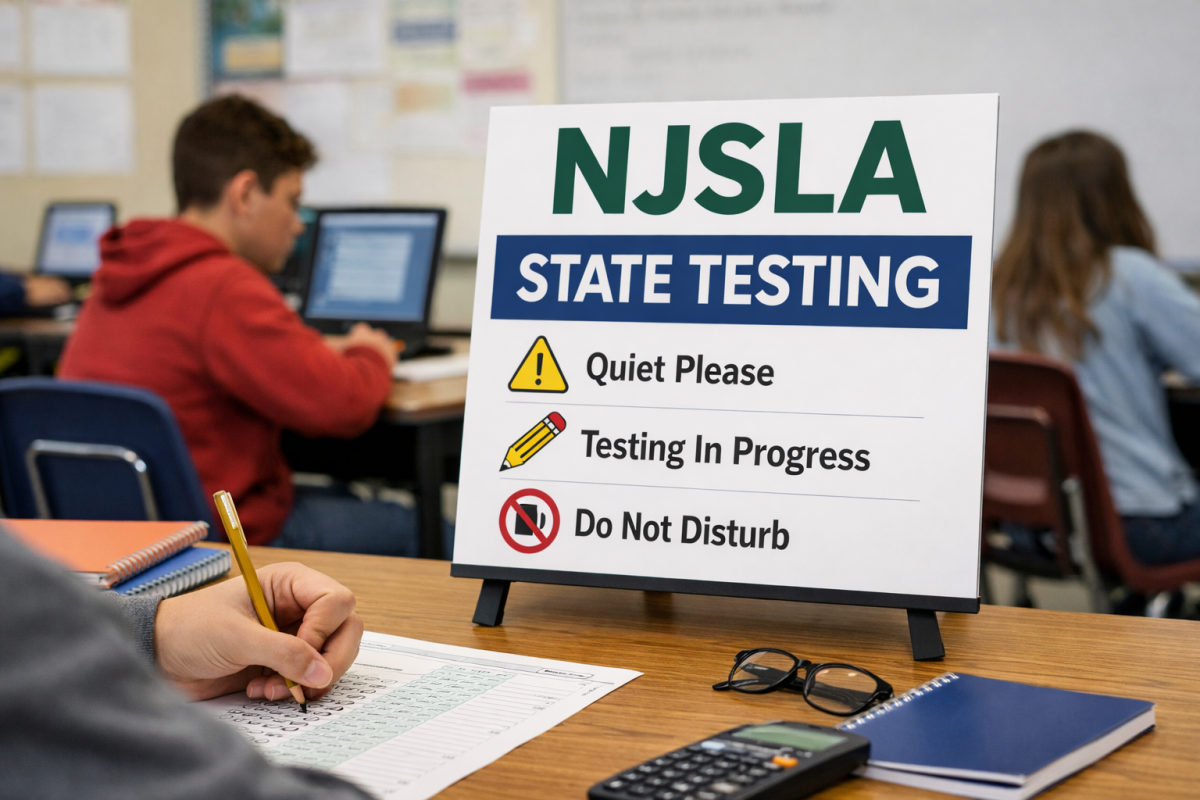
The NJSLA/NJGPA Adaptive Field Test is a new statewide assessment that New Jersey is piloting to help develop future versions of its standardized exams. The assessment marks a shift toward a computer-adaptive model, in which the difficulty of questions adjusts in real time based on student responses. The purpose of the field test is not to assign scores to students but to help the state evaluate test questions, technology, and the overall format. The test is administered over two days and is meant to prepare schools and the state for a full rollout of adaptive testing in the future. According to the administration’s schedule, Grades 9–11 were administered the exam on Wednesday, November 12, 2025, and Grades 9-12 students on Thursday, November 13, 2025.
For many seniors, however, the testing week comes with a pleasant surprise: a two-day late morning start in the middle of the week. With college applications, scholarship deadlines, and extracurricular commitments piling up, the extra time to sleep in or simply reset was welcomed by the Class of 2026.
Senior Gabby Lewandowski shared her mixed feelings about the test schedule: “I think that juniors and seniors already had and have enough state testing, and since it does not really benefit us, there is no incentive for seniors to actually try and show accurate results.”
Gabby also noted that because she did not need to come in for the math section, she took advantage of the free three hours in the morning and squeezed in an early workout. For many seniors, the schedule change feels more like a brief mid-November break than a major assessment week.
Still, not everyone could avoid this exam. Those students who were enrolled in Algebra 2, Geometry, Algebra 1, or Math 8 during the previous school year were required to take the new NJSLA/NJGPA Adaptive Field Test.
Sophomore Olivia Ekberg shared: “The test was fine- I thought it was pretty easy. There was a lot of extra time at the end, and I felt like I had plenty of time, especially for the writing section. The reading part was super easy; I finished it in about 20 minutes. Math was okay, though I really dislike geometry and expected there to be more Algebra 2 since I doubled up, but it was manageable. Overall, it wasn’t bad, but I don’t think it was very useful. Most people didn’t take it seriously since it didn’t count for anything, so it kind of felt like a waste of time because everyone finished in 20 minutes.”
Standardized tests are designed to measure skills and readiness, but if students are not taking them seriously, their purpose comes into question. When kids rush through questions or fill in answers without much thought, the results no longer reflect true ability. This raises concerns about whether these tests provide meaningful data for educators or policymakers. If the test becomes more of a checkbox than a challenge, it risks failing both the students it’s meant to assess and the system that relies on its results.
The irony of the field test is hard to miss: a tool meant to improve future testing may end up highlighting the disconnect between standardized assessments and student engagement and/or achievement. If the most important lesson students take away is how quickly they finish without consequences, what does that say about the design and goals of these exams? Perhaps the ultimate test is not the one on the screen, but whether the system itself can adapt to student realities. Many are juggling rigorous course loads with jobs, sports, clubs, and volunteering, leaving little room for downtime. Mental health and self-care have become part of the conversation, yet students frequently navigate stress quietly while trying to maintain grades and involvement.
In this context, a “low-stakes” standardized test can feel like a disruption rather than a challenge. Even when tests are adaptive and designed to measure skills more precisely, students often see them as an obligation rather than an opportunity, especially if the results do not impact grades or college prospects. For many, the reality of school in 2025 means prioritizing tasks that directly affect their future (and rightfully so!) over one more standardized test.
This reality shapes how students approach field tests: rushed answers, minimal effort, or just using the extra time for rest or unrelated activities. This is not an act of defiance, but a reflection of what students value and what feels relevant to their immediate goals. If standardized tests want to capture an accurate picture of student ability, they need to meet students where they are, acknowledging that modern high school life is packed, competitive, and stressful.
Whether students view this as a helpful preview of future standardized testing or just another unavoidable requirement, one thing is clear: the mid-November testing week brought a unique mix of relief, frustration, and anticipation.