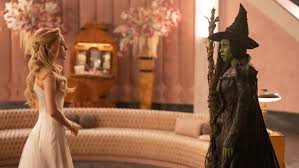
I think it’s safe to say that after watching this movie, we have all been changed- for good. Jon M. Chu, the mastermind behind the film, once again leaves audiences with melodies stuck in their heads, lingering emotions, and a story with messages that truly resonate. With storytelling show tunes, some of which are original to the film, Chu tells the captivating narrative of the final chapters between two best friends who share a bond like no other.
As someone who has seen the original musical on Broadway, allow me to take a clock tick and explain my experience. While watching the movie, I couldn’t help but think that I had forgotten such a charming tune. However, I later realized that “No Place Like Home,” a song performed by Cynthia Erivo as Elphaba in “Wicked: For Good,” was completely original to the film, and enriches a pivotal piece of the plot. The performance captures the moment when Elphaba tries to convince the animals to stay in Oz, despite the constant oppression they face.
The other newly introduced song, “The Girl In The Bubble,” conveys the shift in Glinda’s perspective of her own life. It reveals how Glinda has been living in isolation, and believes that despite her longing to live the unbothered life she has in the Emerald City, reality is setting in.
To begin, the movie opens with the construction of the Yellow Brick Road, a pathway that leads to the Wizard. As seen in Part 1, the road was just an idea presented to Elphaba and Glinda when they entered the Emerald City for the first time. Both impressionable girls praised the idea before knowing the truth about the Wonderful Wizard of Oz, played by Jeff Goldblum. His lack of powers showed Elphaba that everything she had grown up believing was an “illusion of grandeur,” and the Wizard would only use her as a tool to keep his control over Oz. Now, the second film opens up with Elphaba making it her mission to save the animals, and halt the building of the road to keep the citizens of Oz from buying into the Wizard’s deception.
Another touching moment in the film is Glinda’s delivery of “I’m Not That Girl”. This reprise highlights the growing division between the best friends. Though the song may not be as iconic as others in the film, it perfectly captures the undeniable fact that Elphaba and Glinda’s once unbreakable bond has begun to weaken as their lives alter completely. Glinda’s loyalty now lies with the Wizard and Madame Morrible, played by Michelle Yeoh. Glinda indulges in her new identity as “Glinda the Good.” Meanwhile, Elphaba stays true to her morals, even as she finds herself drawn to Fiyero, a love interest who contributes greatly to the frailness of their friendship.
In the end, Wicked: For Good further enhances the beloved reputation of the musical that all began with the film “The Wizard of Oz,” produced in 1939. The movie introduced Elphaba, the Wicked Witch of the West, as a frightening figure, but “Wicked” completely changes the story of the character Dorothy was taught to fear.
“Wicked” has shocked audiences with its vibrant colors, and extravagant set designs. This colorful world draws a direct connection to the new technology of technicolor that was introduced in “The Wizard of Oz.” Astonishing society during the time period, the classic film starts in black and white as Dorothy is in her home in Kansas, but later turns to color once she enters Munchkin Land, amplifying the magic that surrounds the “thrillifying” place. Every little detail poured into the new movie somehow connects to the storyline of the 1939 film, making it all the more legendary.